Regarding the origin of Tai Chi, there have been claims that it originated in the late Yuan and early Ming dynasties, or even in the Tang Dynasty. However, after the examination of historical materials, it has been proven that these claims are specious and unfounded. Both historical records and field investigations demonstrate that Tai Chi was created in the late Ming and early Qing dynasties, with a history of over 300 years to date. It comprehensively inherits and develops various martial arts styles popular among the people and the military during the Ming Dynasty, combines ancient breathing exercises and meditation techniques, and absorbs the classical materialist philosophy of Yin-Yang theory and the meridian theory of basic Chinese medicine, becoming a martial art practiced both internally and externally. Therefore, Tai Chi is essentially a martial art that originated from the masses and integrates various strengths.
For thousands of years, the martial arts techniques created by the working people of various dynasties in China, such as kicking, punching, tripping, wrestling, and grappling, have developed independently. The creator of Tai Chi Chuan integrated various martial arts techniques into the Tai Chi Chuan routine and created the double push hands method (originally known as jie shou or da shou), enabling the practice of various martial arts techniques without protective equipment, and becoming a competitive sport that trains sensitivity in both skin touch and internal body sensation. Therefore, in addition to practicing the bare-handed martial arts techniques (kicking, punching, tripping, wrestling, and grappling) separately, a new content emerged in the late Ming and early Qing dynasties - the push hands method.
After combining Tai Chi with guided breathing and deep breathing exercises, one can not only activate muscles and joints during practice but also harmonize movements with breathing, thereby enhancing internal organ training. Therefore, even as the intensity of exercise gradually increases to the point of explosive power, one can still sweat without panting during practice. After mastering the techniques, one can achieve a state of "unchanging expression" and "unchanging complexion without panting".
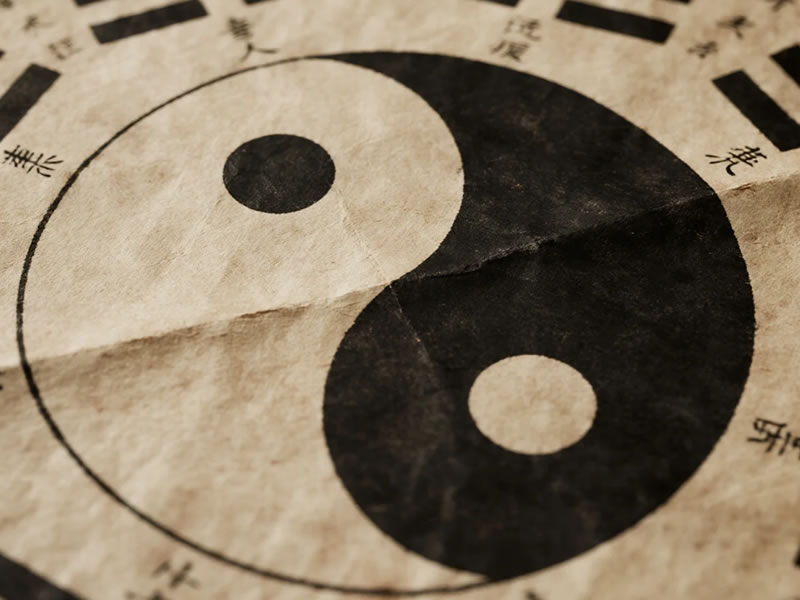
Tai Chi adopts the Yin-Yang theory of classical Chinese materialist philosophy, advocating for "stillness within movement, and movement within stillness" and "the interplay of softness and hardness". Its ultimate goal is to master the art of opening and closing, emptiness and fullness, as well as the harmonious integration of lightness, heaviness, slowness, and speed.
The movements of Tai Chi are curved and spiral, extending and retracting, twisting and turning, always guided by consciousness to circulate qi and blood throughout the body. The internal strength originates from the dantian, with the spine as the axis, transforming through the waist and kidneys, rotating the waist and spine to move the wrists and arms upwards, and rotating the ankles and legs downwards, twisting and moving to the "four extremities" (both hands and the tips of both feet). The internal organs undergo slight self-massage movements, adopting the meridian theory, a fundamental theory of traditional Chinese medicine, which has the function of "communicating the interior and exterior, circulating qi and blood".
When practicing Tai Chi, consciousness, movements, and breathing are coordinated simultaneously. The holistic approach and the unity of internal and external factors in the exercise method become the characteristics of Tai Chi movement.
When we say that Tai Chi is one of the precious cultural heritages of our nation, we mean that it integrates and masterfully combines the excellent achievements of our country's long-standing martial arts, health preservation methods, breathing techniques, meridian theory, classical materialist philosophy, and more.
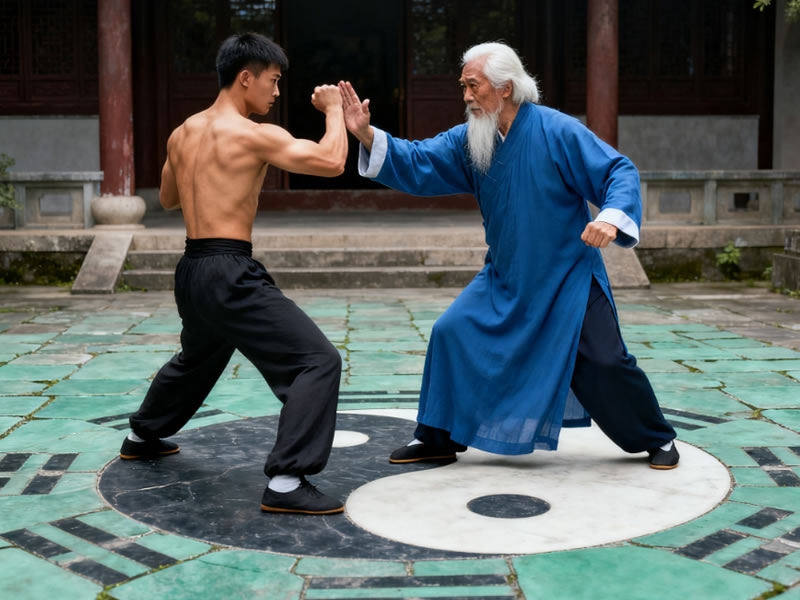
To trace the origins of Tai Chi, one cannot avoid starting with Qi Jiguang (1528-1587), who organized folk martial arts during the Ming Dynasty.
Chinese martial arts have a long history. Due to the vast territory and large population, by the Ming Dynasty, there were already many types of boxing, each with its own strengths and preferences. The famous general Qi Jiguang, in order to train his soldiers' physical agility, drew on thirty-two postures from the renowned sixteen family boxing techniques of the folk, compiling them into a set of boxing routines called the "Thirty-Two Postures of the Quan Jing", which served as the "source of martial arts" for soldiers practicing weapons such as swords, spears, and cudgels. The boxing techniques he drew on extended as far back as the Thirty-Two Postures Changquan of Emperor Taizu of Song, Zhao Kuangyin (927-976). Changquan emphasizes short strikes, using both hardness and softness, embracing diversity, and discarding the dross to retain the essence. The techniques include kicking, striking, grasping, and throwing. Its boxing methods are characterized by "each posture succeeding the previous one, defeating enemies when encountered, and infinite variations", vigorously correcting the prevalent "flower-and-grass" style of flowery but impractical routines for ornamental purposes at that time, becoming a new martial arts school that originated from the masses and met the needs of the times.
Based on existing historical materials on martial arts, Qi Jiguang stands out as an outstanding figure in the study and compilation of folk martial arts. His aim was to serve the political agenda of his time by training soldiers to master martial arts that were "practical for battle", turning them into a formidable force capable of suppressing Japanese pirates in the south and securing the border in the north, thereby safeguarding the country. His advocacy of martial arts serving the military, and the military serving politics, resonated with the ambitions of two other renowned anti-Japanese generals of the time: Yu Dayou (?-1580) and Tang Shunzhi (1507-1560). Qi Jiguang not only humbly learned martial arts that were "practical for battle" and compiled various styles of boxing, but also studied staff techniques from Yu Dayou and spear techniques from Tang Shunzhi. His enterprising spirit, unrestricted by ancient established methods, and bold innovation played a significant role in the inheritance, research, and compilation of martial arts routines for future generations.
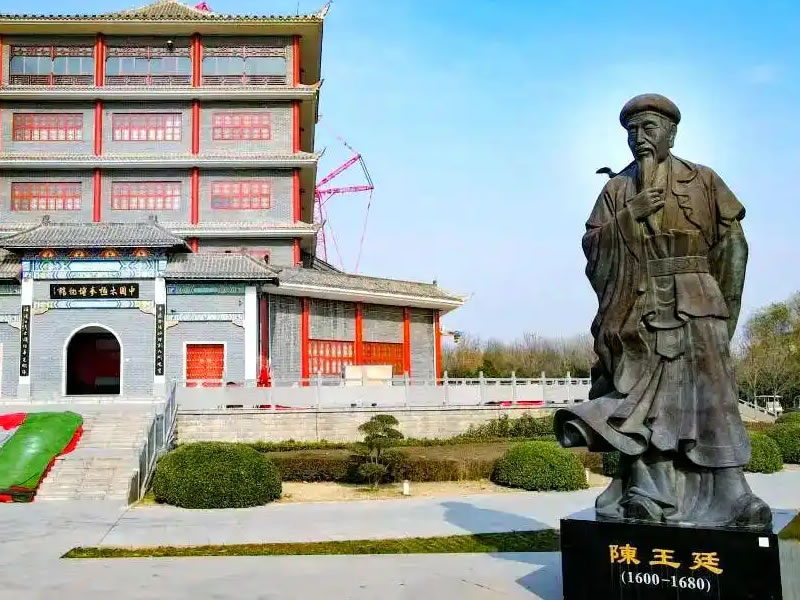
Based on the analysis and research of a large amount of historical materials, it was Chen Wangting of the late Ming Dynasty who, more than half a century after Qi Jiguang, studied and organized various martial arts techniques of the time and created a new school of Tai Chi Chuan. Chen Wangting was born into a small bureaucratic family in Chenjiagou, Wen County, Henan Province. According to the "Chen Family Genealogy", Chen Wangting was also known as Zouting, the ninth generation of the Chen family in Chenjiagou. His grandfather, Sigui, was a local official in Didao County, Shaanxi Province, and his tombstone was erected in the second year of the Kangxi reign. His father, Fumin, was a conscripted scholar. His tombstone was erected in the fourth year of the Kangxi reign. His brother, Yujie, was a scholar and also known as Zoudan, with a tombstone. According to the "Ming Shi Lu" (Records of the Ming Dynasty), Chen Yujie served as an imperial censor in the Huguang Circuit and was promoted to the position of deputy commissioner in Shandong in the first year of the Wanli era. His younger brothers were Wang Qian and Yi Ding. Wang Qian was also known as Zoujun, a scholar, and had a tombstone.
Regarding Chen Wangting's martial arts, the "Chen Family Genealogy" only records: "He was renowned in Shandong... and was the founder of Chen's fist, spear, and sword techniques."
Around the time of the fall of the Ming Dynasty in the Jia Shen year (1644), Chen Wangting had already retired into seclusion due to old age. He created a martial art for self-entertainment and taught it to his disciples, children, and grandchildren. The first half of his funeral oration reads: "I sigh for the past, when I wore armor and held a sword... I faced several dangers! I was granted favor, but it was in vain! Now, I am old and frail, with only the 'Huang Ting' scroll as my companion. When I feel bored, I create martial arts; when I am busy, I till the fields. In my spare time, I teach my disciples, children, and grandchildren, allowing them to become dragons or tigers as they please..."
According to the "Chen Family Martial Arts Manual", the boxing sets created by Chen Wangting include five styles of Taijiquan (also known as the Thirteen Forms), one style of Changquan with 180 forms (with no duplicate form names), and one style of Paochui. Qi Jiguang's "Boxing Classic" alone, with its 32 forms, was absorbed into 29 of these styles.
Chen Wangting was an outstanding figure in the compilation of folk martial arts after Qi Jiguang. His extensive contact with martial arts masters facilitated the integration of various strengths, allowing him to inherit and innovate.
After successfully resisting the Japanese invaders in the south, Qi Jiguang was transferred to the north. In the second year of the Longqing era of Emperor Mu of the Ming Dynasty (1568), he "was in charge of the military affairs of Jiyu, Changchun, Liaoning, and Baoding, supervising the four towns and acting in concert with the governor-general" (see Qi Zhaoguo's "Annals of Qi Shaobao"). It was not until 1583 that he was transferred to Guangdong. The "History of the Ming Dynasty" states: "Qi Jiguang served as a general for sixteen years, refurbishing the frontier defenses, and the Jiyu Gate was in a peaceful state. Those who followed him continued his successful methods, and for several decades there was no trouble.".
Chen Wangting was significantly influenced by Qi's teachings when compiling martial arts routines. Qi's "Quan Jing" (Fist Classic) encompasses thirty-two postures, integrating sixteen ancient and modern boxing techniques, selecting the essence and discarding the dross, and compiling these thirty-two postures into a set of boxing routines, serving as the "source of martial arts" for soldiers to practice their skills. Chen Wangting absorbed twenty-nine of these postures and incorporated them into the Tai Chi Chuan routine. (Note 1) The thirty-two postures in "Quan Jing" begin with the "Lan Zha Yi" (Lazy Clothing), and Chen Wangting's seven sets of boxing routines also begin with this posture. The boxing manuals (i.e., the names of the boxing forms) and the "Quan Jing Zong Ge" (General Song of the Fist Classic) also draw from the text of Qi's "Quan Jing". Therefore, it can be said that the creation of Tai Chi Chuan is based on the thirty-two postures of "Quan Jing". As for what was absorbed from other martial arts styles, although it is impossible to verify, the multitude of posture names in the seven sets of boxing suggests that a considerable number of martial arts styles were incorporated. The methods of double push hands and double stick holding are not documented in the martial arts writings of Yu Dayou, Qi Jiguang, Tang Shunzhi, Cheng Chongdou, He Liangchen, Mao Yuanyi, etc. Nor are these training methods found in any of the existing martial arts styles. These are Chen Wangting's original competitive methods, which solved the problem of practicing unarmed combat skills and improving spear thrusting techniques without protective gear. This is also a creative achievement in the history of Chinese martial arts.
The opening two sentences of Chen Wangting's "Quan Jing Zong Ge" ("Quan Jing" refers to the basic principles of technical training in push hands, which include the eight methods and techniques of "Bing (lifting, holding, stepping, pressing, adopting, changing, elbowing, and relying on) and the principle of adhering to and not letting go, as well as the technique of introducing and letting go"), summarize the characteristics and methods of "push hands". By the end of the 18th century, Wang Zongyue (according to the preface to Wang Zongyue's "Yin Fu Gun Spectrum" by an anonymous author, Wang Zongyue was in Luoyang in 1791 and in Kaifeng in 1795, and his occupation was teaching), as well as Wu Yuxiang (1812-1880) and Li Yiyu (1832-1892) from Yongnian, Hebei in the mid-to-late 19th century, developed the theory and practice of Tai Chi Chuan based on these principles. Chen Xin (1849-1929), a member of the 16th generation of the Chen family in Chenjiagou, elaborated on the accumulated experience of practicing boxing over the ages and wrote "Chen's Tai Chi Chuan Illustrations" over a period of 13 years. He detailed the principles and methods of each posture, explained the principles of Tai Chi Chuan using the principles of the Book of Changes, and combined it with meridian theory. His boxing method is based on the principle of combining hardness and softness, alternating speed and slowness, and changing between accumulation and release, with the core role of silk-like strength and internal strength as the guiding force. These classical Tai Chi Chuan papers have become guiding theories for practicing Tai Chi Chuan and push hands.
Upon reviewing the martial arts materials handed down by Chen Wangting, it is evident that he made several creative achievements during the research and collation process.