At some point, modern people began to dig out the ornaments popular in ancient times from the bottom of their boxes and, following suit, added more ideas and embellishments. Thus, thick and thin ribbons woven with colored threads, small rings with totemic patterns, and graceful tassel pendants all came together to form the beautiful and unique Chinese knot. It's amazing how a simple red string can be transformed into so many patterns.
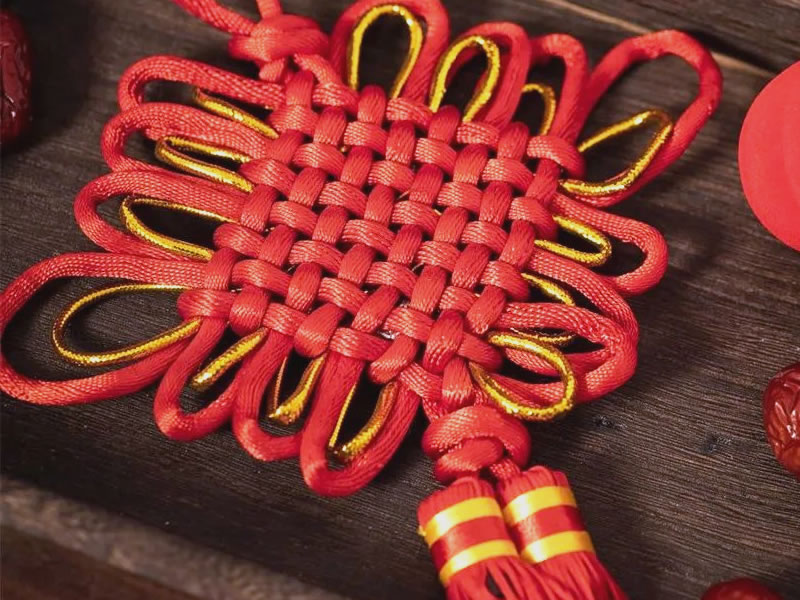
Don't underestimate this small Chinese knot. The sentiment and wisdom it embodies are a facet of ancient Chinese civilization, representing people's pursuit of freedom and their wish for peace.
"Knot" is a rope-woven ornament, which, together with China's cloth art and embroidery, is known as one of the three major handicrafts of our country. It is simple and unpretentious, yet dignified and elegant.
Speaking of Chinese knots, they have a long history that spans the entirety of human history. The long-term cultural accumulation has imbued Chinese knots with the unique and pure cultural essence of the Chinese nation.
"Shén" and "shéng" are homophones, and in the early stages of Chinese culture, ropes were once worshipped. According to written records, "Nüwa drew a rope in the mud and lifted it up to create humans." Since ropes resemble coiled dragons, and Chinese people are descendants of the dragon, the image of the dragon god was represented in prehistoric times through variations in knot patterns.
The word "jie" (结) also signifies strength and harmony, evoking a sense of reunion, intimacy, and warmth. As "jie" and "ji" (吉) share a similar sound in Chinese, and "ji" represents the eternal pursuit of human beings, the vibrant folk art of "shengjie" (绳结) has naturally become an essence of Chinese traditional culture, thriving and enduring to this day.
Chinese knots are woven from a single thread from start to finish, and each basic knot is named according to its shape and meaning. By combining different knots or matching them with other decorative items featuring auspicious patterns, traditional Chinese auspicious decorative items with unique shapes, vibrant colors, profound meanings, and rich connotations are formed.
The material is red thread, and there are many types of threads, including silk, cotton, linen, nylon, blended fabrics, etc., all of which can be used for braiding. The choice of thread depends on the type of knot being made. However, when using threads for Chinese knotting, in general, not only will the pattern of the knot be obscured, but the inherent beauty of the thread itself will also be overshadowed by the interference of the knot's lines. The hardness of the thread should be moderate. If it is too hard, it will not only be inconvenient to handle during braiding, but the shape of the knot will also be difficult to grasp; if it is too soft, the resulting knot will not be upright and the outline will not be prominent, making the knot and the object blend together and exhibit a dynamic rhythmic beauty in its swaying. Different textures of threads can be used to create works of different styles.
When selecting threads, one must also pay attention to color. For decorative knots crafted for elegant items such as ancient jade, straight threads with more subtle hues, such as coffee or dark green, are preferred. However, when creating decorative knots for items with monotonous shapes and deep colors, various types of threads can be used to craft knots with diverse forms and charm. Among them are double thread, button, pipa, tuanjin, cross, auspicious, swastika, panzhang, caisson, double-linked, butterfly, and other knot patterns.